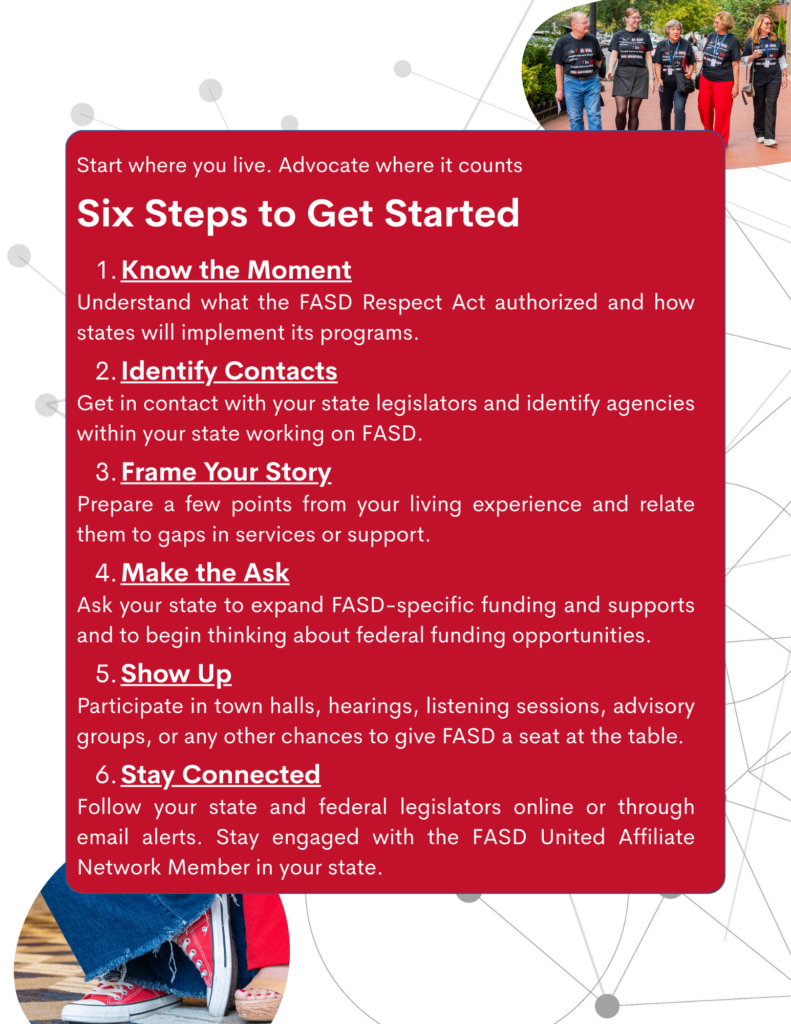
Understanding where fetal alcohol spectrum disorders (FASD)is being addressed within your state’s systems is essential to improving how people with FASD and their families are supported. This work also prepares states to successfully implement programs authorized under the FASD Respect Act. Federal policy alone does not create change. Now, our advocacy must bring awareness and coordination to states so they have the capacity to act.
FASD is complex and intersects across many systems. Healthcare, education, disability services, substance use systems, mental health systems, child welfare, and the justice system all interact with individuals with FASD, whether they recognize it or not. For meaningful progress to occur, these systems must become FASD-informed and aware of the direction provided by the FASD Respect Act.
From Federal Policy to State Action
Until recently, much FASD advocacy focused on gaining recognition and support at the federal level. Advocacy around the FASD Respect Act helped build consensus around the need for an updated and coordinated national response to FASD.
The question is no longer whether states can act on FASD, but how they will do so.
Many of the programs authorized in the law are designed to strengthen state capacity. States will determine which programs are prioritized, how services are accessed, and how coordination happens across systems. Engaging with state leaders and agencies now helps ensure that these programs lead to meaningful, sustainable supports.
What Do We Mean by “Systems”?
Systems are the public structures and institutions that provide services, oversight, and support for state residents. They operate through state agencies, programs, policies, and regulations.
For example, a state’s education system may include a Department of Education, offices responsible for special education or higher education, federal frameworks such as IDEA or Section 504 of the Rehabilitation Act, and local school district policies. Similar layers exist across health, behavioral health, and social services systems.
Because these systems often operate independently, coordination is not automatic.
FASD Cuts Across Systems
FASD does not fit neatly into a single system or category. When it is not explicitly recognized within programs or policies, it can easily fall through the cracks.
Different systems may address FASD under different labels or not identify it at all. Eligibility requirements, documentation standards, and funding streams vary widely. As a result, individuals and families may experience repeated referrals, inconsistent identification, or gaps in support.
Mapping, Meeting, and Building Partnerships
Identifying who is already working on FASD or whose work intersects with it creates opportunities for collaboration and education. Mapping contacts across agencies helps advocates understand where conversations can begin.
Tracking outreach and follow-up helps ensure those conversations develop into relationships rather than one-time meetings. Over time, these relationships create shared understanding, trusted points of contact, and internal champions who can move FASD-informed practices forward within their agencies.
Success in this work is not measured by immediate change, but by progress: stronger connections, clearer pathways, and systems that are increasingly informed, aligned, and ready to respond.
Start With One Step
State advocacy is not about creating something entirely new. It is about clarifying how existing programs and services include people with FASD, strengthening coordination between agencies, and bridging the gap between living experience and professional expertise.
Start with one step. Identify a system in your state. Find the people working within it. Start the conversation.
Over time, those conversations can build the connections needed to create systems that better support people with FASD across the lifespan.