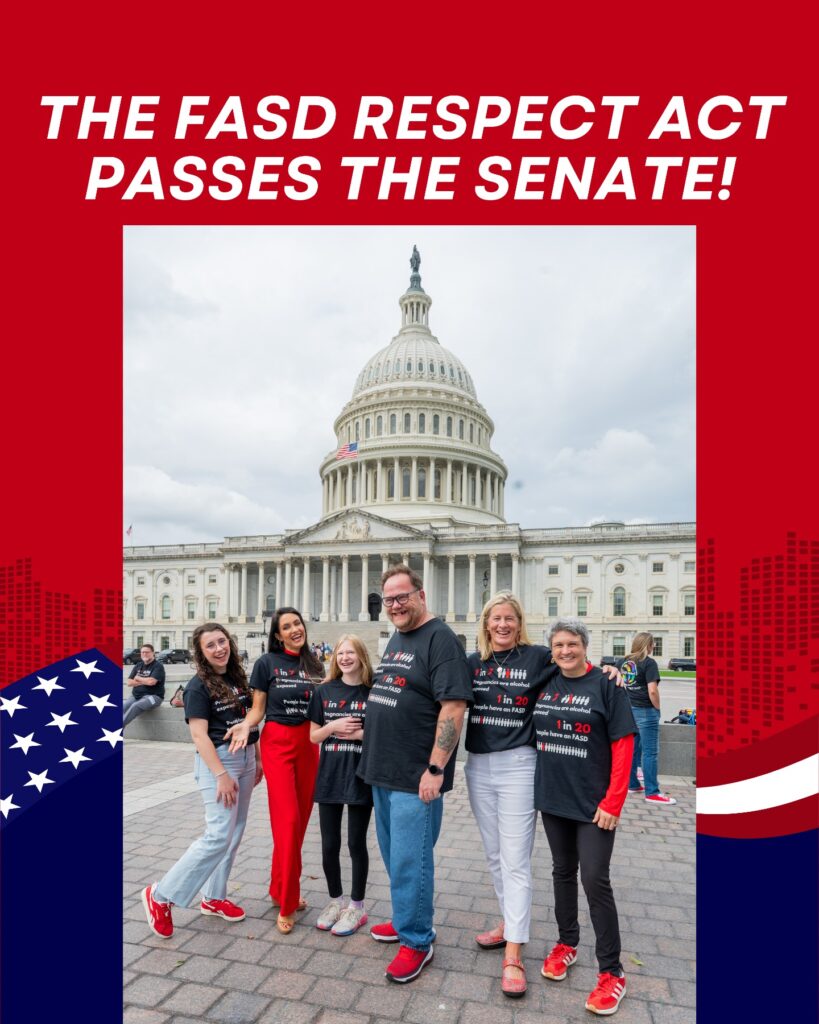
Two short days after over 100 advocates visited Capitol Hill during National FASD Impact Week, the United States Congress passed the SUPPORT for Patients and Communities Reauthorization Act of 2025 (H.R. 2483), which includes authorization of the FASD Respect Act. This marks the most significant federal recognition of fetal alcohol spectrum disorders (FASD) in decades and will update the federal response to prenatal alcohol exposure.
The next step is for the bill to be presented to the President. There is no Constitutional timeframe dictating when a passed bill must be sent to the President’s desk. Once the bill is presented to the President, he will have ten days to sign the bill into law. If the President does not sign the bill within ten days, and Congress has not adjourned for the session, the bill is still passed. The President can veto the bill, sending the bill back to Congress who can override the veto.
FASD United will be sure to make an announcement as soon as bill is presented to the President.
It has been nearly twenty years since authorization for FASD programs lapsed, leaving funding for support services, research, and prevention at risk. Passage of the FASD Respect Act provisions through the SUPPORT Reauthorization Act secures funding authority for FASD through FY2030. This comes at a critical time, as public health budgets have faced significant constraints in recent years.
What This Means
Passage of FASD Respect Act language guarantees:
- Federal Action: This authorizes the Department of Health and Human Services to update and create new programs focused on education, awareness, intervention, and prevention.
- Support for States and Indigenous Nations: Resources will be directed to strengthen FASD-informed services within existing systems of care, ensuring greater awareness and support.
- Recognition: Grassroots, community-driven advocacy led to this achievement. Congress has committed to working for you, your family, and your community.
- A Foundation: By reauthorizing FASD programs, we now have a base to build from. Awareness, support, and funding are still lacking, and we will continue to work towards an FASD-informed society.
Champions
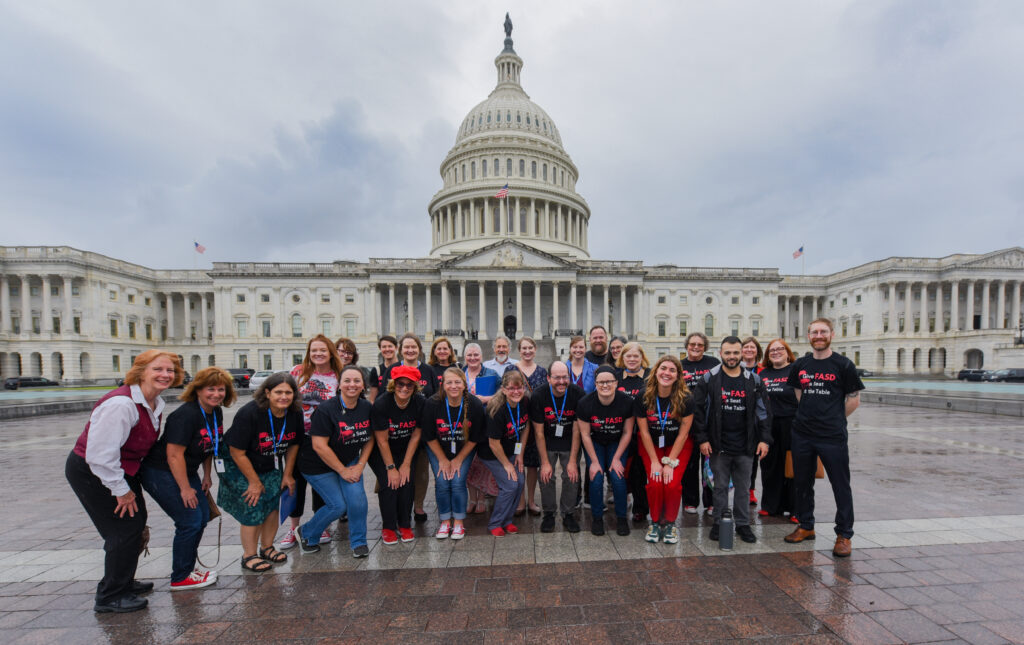
This achievement reflects the tireless work by self-advocates, families, professionals, and organizations across the country. The same week the Senate voted to enact FASD provisions, advocates from across the country met with their legislators in Washington, DC, to educate them on prenatal alcohol exposure and to urge them to pass the FASD Respect Act as part of H.R. 2483. After hearing the news of the bill’s passage, one advocate stated how they wished that the bill passed while they were still in Washington, DC. FASD United Board Chair, Michael Keawe Anderson, then asserted, “This may not have happened while you were there, but it happened because you were.” Passage of this bill underscores the power of grassroots advocacy.
The bipartisan leadership from Senators Lisa Murkowski (R-AK) and Amy Klobuchar (D-MN), along with Representatives Don Bacon (R-NE-2) and Betty McCollum (D-MN-4), has been both indispensable and inspirational. All four Members and their staffs were deeply committed to seeing this through and have displayed a welcome willingness to learn from the FASD community. These four Congressional champions, along with every Member who cosponsored the legislation along the way, are deserving of our gratitude for this win.
As a mom and self-advocate, I see the passage of FASD Respect Act provisions as a turning point. It acknowledges FASD as a lifelong, whole-body condition and ensures families are no longer left navigating this journey alone. It’s progress, recognition, and hope for every family touched by FASD.
Laura Bousquet

What Comes Next
Passage of the FASD Respect Act was a necessary step toward enacting more specific legislation to provide direct services and to ensure all systems of care are FASD-informed. While this is certainly a victory for the community, work will continue to ensure that all provisions within the bill are fully funded. Actual funding for FASD programs has been stagnant for two decades, but now Congress is starting to better understand the complexities of FASD and the need for federal leadership.
As this community continues to build on this foundation, this achievement should stand as a testament to what is possible when self-advocates, families, professionals, and organizations work together for good.
Join the Table
There is a role in advocacy for everyone, and we hope you will join us and discover what role best suits you. Advocates can meet with their legislators over Zoom, send emails or letters, write op-eds, or take any action that amplifies the voices of this community. Want to learn more? Join us this Wednesday, September 24, at 2:00 pm Eastern for our Monthly Policy Forum.
Join Zoom Meeting
https://us06web.zoom.us/j/89258294486?pwd=QzJFZFpjNER3NzEzZDdUWTFxcVl4UT09
Meeting ID: 892 5829 4486
Passcode: 454311