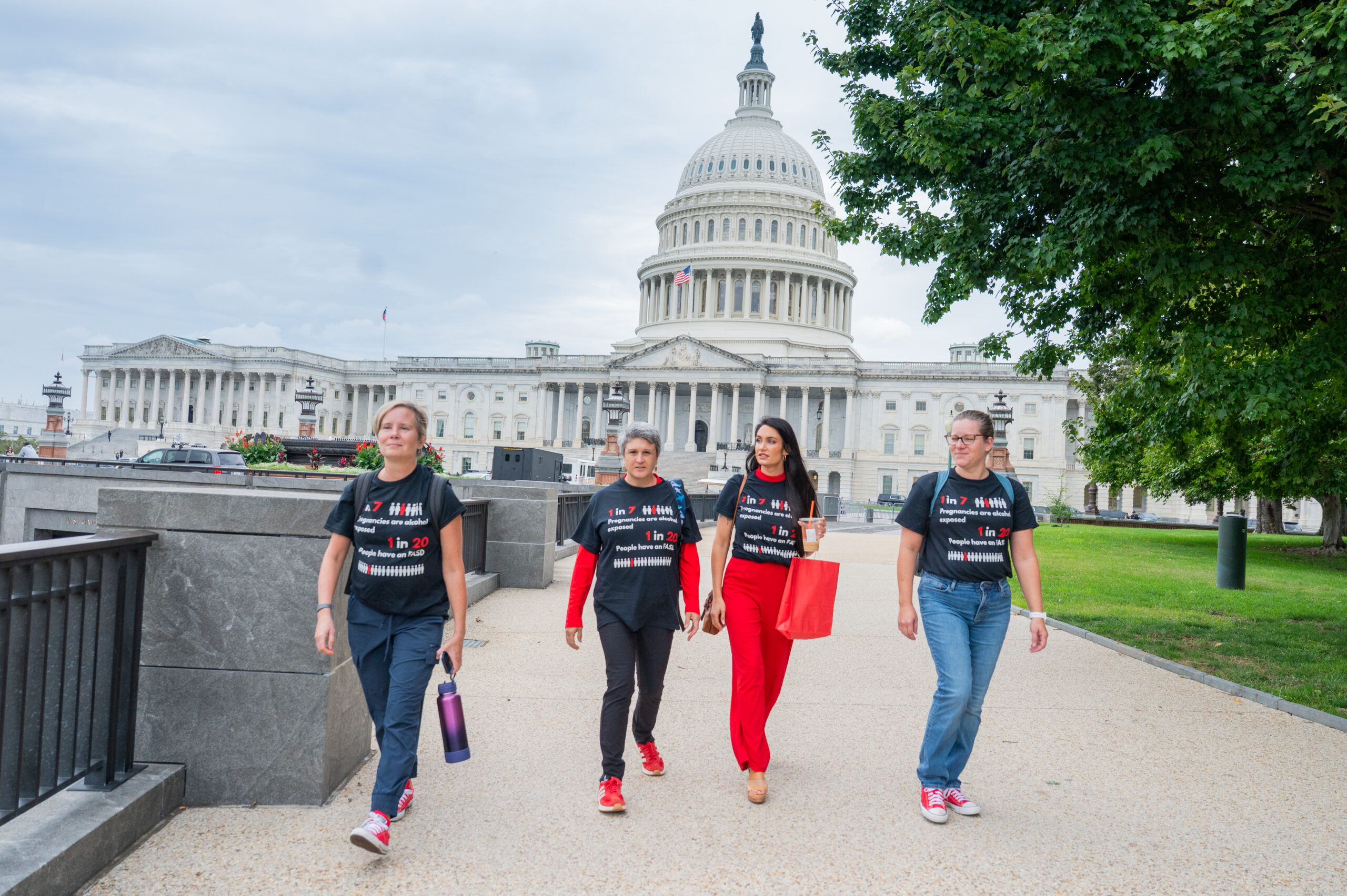
On Thursday, July 24, advocates visited Capitol Hill to meet with the offices of Senators Amy Klobuchar (D-MN), Tim Kaine (D-VA), and Mitch McConnell (R-KY) to discuss FASD policy priorities, the importance of federal funding, and how state and community efforts can improve outcomes for individuals with an FASD and their families.
Senator Amy Klobuchar, a longtime champion for the FASD community and original sponsor of the FASD Respect Act, reaffirmed her commitment during a meeting with ALC Changemaker Emily Hargrove and Dr. Christie Petrenko of the University of Rochester’s Mt. Hope Family Center. As part of their visit, Emily and Dr. Petrenko had the opportunity to film a portion of their conversation with the Senator for their highly anticipated documentary, FASD: In Pursuit of the Respect Act.

Meeting with Senator Kaine’s Office: Support and Virginia’s Role
In a productive meeting with Senator Kaine’s staff, advocates discussed the importance of the FASD Respect Act (S.139) and its inclusion in the broader SUPPORT Reauthorization Act (S.2121). Senator Kaine sits on the Senate Committee on Health, Education, Labor and Pensions, which has jurisdiction over the FASD Respect Act and the SUPPORT Reauthorization Act.
We also spoke about how FASD is addressed in Virginia, highlighting local efforts and gaps in services. The conversation included practical strategies for constituent engagement, with staff noting that advocates should take advantage of telephone town halls and virtual roundtables, which they can find on legislators’ websites or in their weekly newsletters.
Meeting with Senator McConnell’s Office: Federal Strategy and Defense Appropriations
Separately, a group including Emily Hargrove, Dr. Christie Petrenko, and Kate Boyce met with Senator McConnell’s health policy staff. The group shared personal experiences and research-backed data to emphasize the urgent need for a coordinated federal response to FASD.
A key point of discussion was the role of defense appropriations in funding FASD research and programming through The Center for Health Services Research (CHSR) at Uniformed Services University of the Health Sciences in partnership with FASD United. Advocates highlighted how continued and expanded funding in this area supports service members and families, advances diagnostic tools, and fills critical research gaps.
Why It Matters
FASD is a lifelong, full-body disability that affects up to 1 in 20 people in the United States. Yet despite its prevalence, federal coordination and funding remain fragmented. These meetings reflect a growing recognition in Congress that early intervention, thoughtful prevention, and sustained support services are essential to improving health outcomes, reducing costs, and promoting long-term success for individuals with FASD and their families.
Our thanks go to the offices of Senators Klobuchar, Kaine, and McConnell for their time and engagement, and to the self-advocates, researchers, and family members who continue to lead these important conversations.