A crucial piece of effective FASD advocacy is understanding the budget process for the U.S. Federal Government and how FASD fits into it. The federal budget is not just a listing of numbers; it is an overview of the priorities of the President (executive branch) and the Congress (legislative branch). The budget process, while complex, affords advocates numerous meaningful opportunities to engage at every stage—from authorizing programs to ensuring they are fully funded.
The FASD United Policy and Training Center works to empower advocates to share their experience and expertise to illuminate the real-life implications of funding FASD supports and including FASD in existing healthcare funding.
While the urgency of the issue is clearly understood by advocates, with FASD affecting up to 1 in 20 children, the community has historically received little attention in federal funding. Federal investments in prevention, diagnosis, and support have fallen far short of what the true scale demands. That’s where advocacy comes in.
Each year, Congress decides how federal dollars are spent through a multi-step budget process that affects everything from highways to healthcare. Advocates have a major role to play in how these decisions are made.
Advocates are empowered through understanding the Federal budget process
It is extremely useful for advocates to develop an understanding of how the federal budget is created and implemented. By illuminating this process, we shine a light on the advocacy pressure points present throughout the process. From the President’s budget request to final votes, advocates can influence legislators and directly impact how programs and services are funded. The process can be complex and lengthy, but understanding a few key concepts can provide a clearer roadmap for advocates.
The President’s Budget Request is essentially a proposal for Federal spending. While it is a detailed plan with specific recommendations and dollar amounts, it is not actual law or policy. It functions as a statement of priorities and a starting point for Congress.
A Congressional Budget Resolution is an agreement or blueprint passed by Congress that outlines overall Federal spending in broad categories, though it does not directly appropriate funds.
A Congressional Authorization is a law that creates or continues a program, establishing the framework for how it should function and what it is able to do. While authorizations may include suggestions for funding levels, these funds will still need to be appropriated. Authorization can be thought of as both the blueprint and the permit. The FASD Respect Act and the SUPPORT Reauthorization Act are examples of this type of bill.
An Appropriation Bill provides the actual funding for authorized programs. Each chamber must pass 12 appropriation bills annually through the Appropriation Subcommittees. These bills start in specific subcommittees and committees before being heard by full House and Senate. During this process, the bill will go through markups, where members have the chance to make changes to funding levels. Oftentimes, appropriation bills are rolled together into packages called omnibus bills.
- Omnibus Appropriations Bill: When a budget deadline is approaching and Congress has not passed all 12 appropriation bills, the bills can be bundled packages called omnibuses. While this method does allow Congress to work quickly, an omnibus bill can also contain unrelated policy provisions and can be difficult to amend. Often, there is an all or nothing vote on the budget or risk a Government shutdown.
- A Continuing Resolution may be enacted when a budget is not agreed to. A continuing resolution usually maintains current funding levels and is a stopgap measure, allowing Congress to agree on final appropriations.
Where the FASD Respect Act and SUPPORT Reauthorization Act Fit In
The FASD Respect Act (S.139, Respect Act) is bipartisan legislation addressing FASD at the federal level, introduced during the current 119th Congressional Session. Provisions from the Respect Act are included in The SUPPORT for Patients and Communities Reauthorization Act of 2025 (S.2121, SUPPORT Act), which is a package of bills reauthorizing a broad range of programs and services related to substance use support, prevention, and treatment. FASD provisions were included in the SUPPORT Act due to grassroots advocacy from the FASD community paired with sustained relationships between organizations like FASD United and key legislators.
The SUPPORT Act has passed the U.S. House, with provisions from the FASD Respect Act included as Section 104: Support for individuals and families impacted by fetal alcohol spectrum disorder. This bill has been sent to the Senate Committee on Health, Education, Labor, and Pensions (HELP), where it awaits a committee hearing.
FASD provisions within Section 104 of the SUPPORT Act would require the Secretary of Health and Human Services (HHS) to:
- Continue, establish, or improve programs and services for FASD education, intervention, prevention, and support delivery.
- Provide funding to State and Tribal Systems for FASD Services throughout the lifespan. Include a definition of FASD-informed in Federal code.
- Strengthen nationwide, state and tribal capacity to identify, treat, and support individuals with FASD and their families.
One difference between the language in the standalone FASD Respect Act and the language in section 104 of the SUPPORT Reauthorization Act is how each bill deals with the authorization of funding. The FASD Respect Act uses “such sums as may be necessary” language, directs Congress to determine funding levels for programs and services through the typical budget and appropriations process stated above. The SUPPORT Act, on the other hand, suggests that $12.5 million be appropriated to fund the services and programs created by the bill. While this does not guarantee that $12.5 million will be ultimately appropriated, it serves as recommendation from the authorizing committee (in this case, the Senate HELP Committee) to the appropriations committee (Senate and House Appropriations Committees, Subcommittees on Labor, Health and Human Services, Education, and Related Agencies).
The Benefits of Support and the Costs of Inactions
The costs of inaction are high, not only in dollars but in the everyday lives of individuals and families with FASD across the country; support needs are not addressed in schools and the workforce, and our systems of care are equally ill-equipped to provide supports needed throughout the lifespan.
The direct financial costs of inaction are immense. The average lifetime financial cost per person with FASD is estimated at $2.0–2.4 million. Each new annual birth cohort of mostly undiagnosed/unsupported people with FASD is estimated to cost $1.7–2.0 billion per year, representing countless opportunities to invest in the lives of members of our community, reducing costs and preventing adverse outcomes.
We need to consider some of the specific drivers of these costs: healthcare, education, justice, and employment. Healthcare costs can be 3-10 times higher among individuals with FASD, including spending on a range of issues including heart defects and chronic disease. Education costs 2–3 times more per student with FASD.

Consider the societal benefits of investing in FASD supports using the “curb-cut effect” as an example. Originally meant to assist wheelchair users, curb cuts are helpful to parents with strollers, cyclists, and delivery workers. This principle applies directly to FASD supports. When our healthcare, education, and other systems are designed to meet the complex and often non-apparent needs of individuals with FASD, they become more responsive to the entire population. By investing in FASD-informed approaches, we make our systems of care more efficient, effective, and resilient for everyone. These improvements reduce long-term costs, prevent crisis-driven spending, and build stronger communities.
Funding for FASD yields a positive return on investment
Funding that addresses FASD and supports individuals with the disability is a sound investment in the future, with well-documented returns for every dollar spent. Funding support services for families, in addition to improving countless lives within our community, is good economic policy that saves money in the long term by preventing future costs and helping people lead happy and healthy lives.
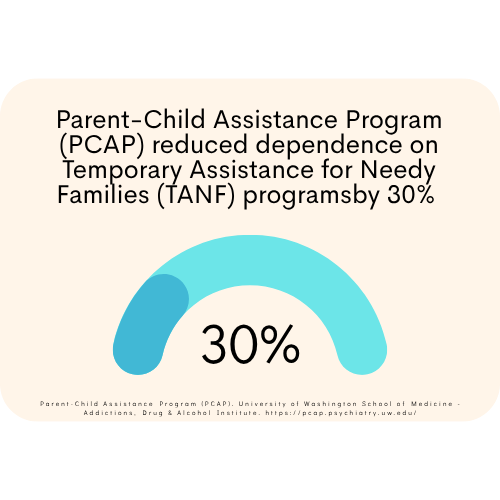
Alcohol screening and brief interventions (SBIRT) returns $4-$5 per $1 invested, in addition to improving the lives of children and adults by reducing alcohol exposed pregnancies. Early diagnosis before age 6 reduces adverse outcomes by 2-4 times. The Parent-Child Assistance Program (PCAP) reduced TANF reliance by 30% in WA State. These programs are cost-effective but require stable funding — often via Medicaid, HRSA, CDC, or state block grants.

The Center for the Developing Child at Harvard University has shown that one in three infants and toddlers who received early intervention services did not later present with a disability or require special education. Early intervention has been shown to “contribute to a child’s mental health and overall success in adulthood.” This directly translates into cost-effectiveness for states. A Wisconsin study found that every $6,730 invested in a child for early intervention generated a total return of $47,759 per participant through fewer special education services, less grade retention, and less juvenile delinquency. Few programs can laud such success in a community; however the recent Medicaid cuts passed by Congress risk reducing funding towards these programs, necessitating the need for greater investment.
When it comes to public health, evidence supports investing 1% of the total cost of a health issue on prevention and support. With an annual cost of $215 billion, a 1% investment for FASD would be $2.15 billion, far higher than the current level of $42.4 million, which works out to only 0.02% of the total annual cost. An example of a health issue that meets this investment target is Alzheimer’s, which received $3.8 billion in NIH support in FY24, 1.05% of its annual cost of $355 billion/year. Given its prevalence and impact on families, FASD should be funded at this level.
We are calling on FASD advocates to take action.
We need all of us to get involved and make a difference in the lives of individuals and families with FASD. Inherent in the complex budget and appropriations process are advocacy pressure points. While Congress has the final say on how money is spent by the Federal government, we can influence their decisions (we can even influence the groups who influence Congress).
| Timeframe | Action | Advocacy Pressure Point |
| January-March | President’s Budget | Respond to helpful or harmful proposals through letters to the editor or op-eds. Attends townhalls or other events. |
| April-May | Congressional Budget Resolutions | Meet with legislators and share what has helped you and where support is needed |
| June-July | Subcommittee hearings and markups | Advocate for FASD to be included in other funding streams |
| August | Congress in Recess | Meet with legislators in their home offices |
| September | Final budget/appropriations votes | Final push! Call, write, and meet with your legislators to urge their support of FASD funding |
Here are some actions you can take:
- Share your personal stories of how specific programs and services have supported you.
- Spread the message that investing in support for FASD isn’t just the right thing to do, it is a smart financial investment in the future that will save money and reduce costs.
- Meet with legislators and partner with FASD United in asking them to champion FASD legislation and funding.